Energy Flexibility Framework

The UPCHANGE project has reached an important milestone with the completion of Deliverable D1.2 – Energy Flexibility and Resilience Framework
This research tackles a common gap: there is no structured, data-driven way to identify which district-heating connected buildings are best suited for demand-side management (DSM) at scale. The approach combines large-scale datasets with stakeholder input (utility companies and building owners) to reflect context-specific requirements.
The framework draws on three main data sources:
-
Smart Heat Meter (SHM): In Denmark, utility companies typically collect hourly SHM data. This usually includes cumulative heat use, flow, and supply/return temperatures, enabling detailed insight into a building’s daily energy use profiles.
-
Building and Dwelling Register (BBR): A publicly accessible national register with comprehensive information on buildings, dwellings, commercial units, and technical installations across Denmark.
-
Energy Performance Certificate (EPC): Mandatory for private buildings at construction, sale, or rental, and for public buildings. Danish EPCs are stored in a central register with public access to both inputs and outputs (including the energy label), enabling component-level analysis for certified buildings.
These datasets provide the basis for defining key performance indicators (KPIs) to support building selection, with a particular focus on thermal characteristics. For instance, BBR can supply construction year, while EPC data can be used to derive metrics such as an overall heat-loss coefficient.
An interactive data-visualisation interface supports transparent, traceable selection of candidate buildings, while keeping detailed information accessible throughout:
-
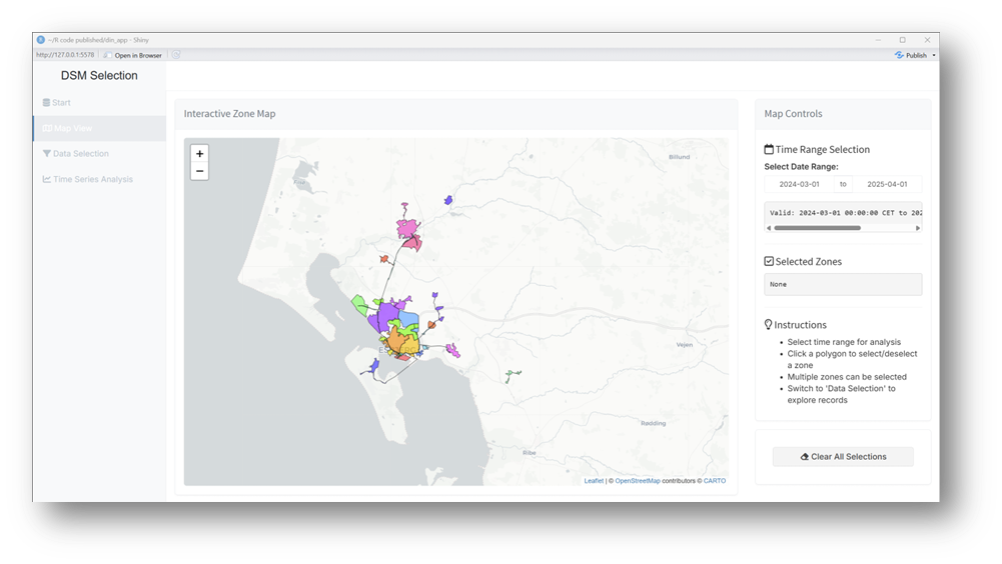
Users can choose a geographical area and time range,
-
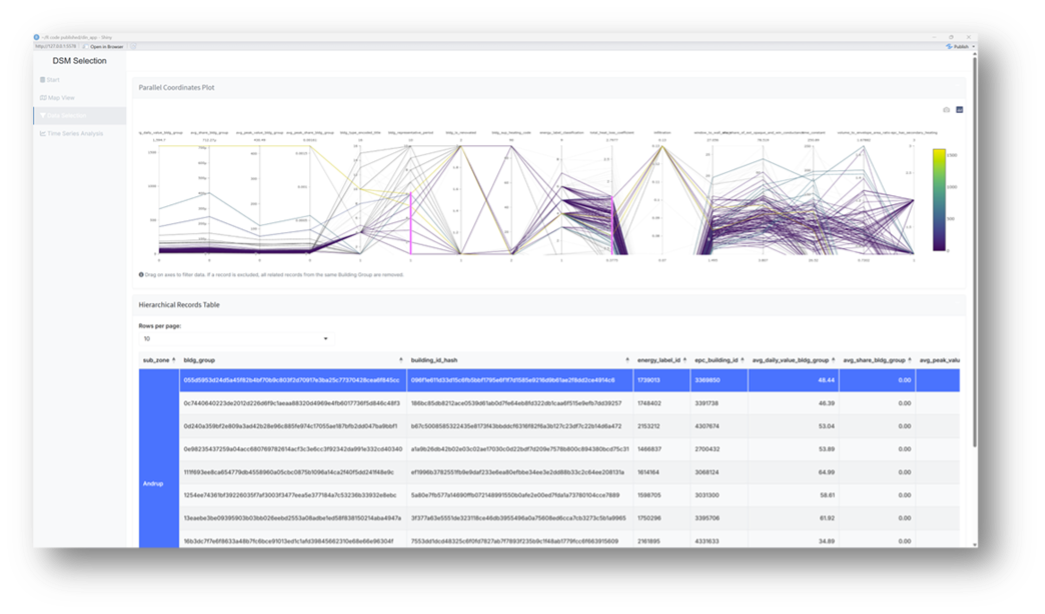
Filter buildings based on defined KPIs using an interactive parallel coordinates plot (PCP) alongside a sortable table, and,
-
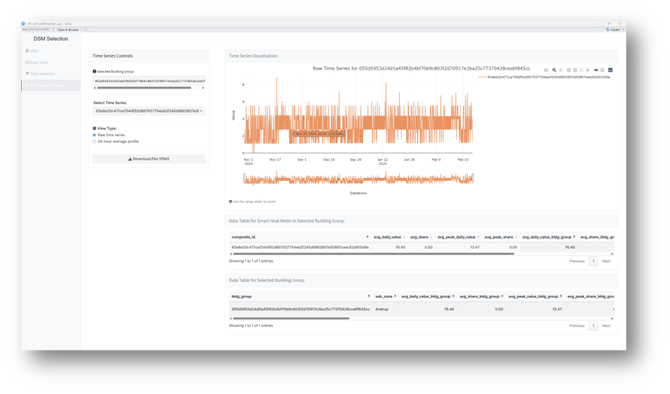
Explore time-series behaviour for selected buildings – for example, aggregated 24-hour average profiles – together with associated meter and building information